Language:en 
- zh-cn
- en
- ja
- fr
- ko
- de
- pt-pt
- es
FLAM Electronics



Capacitors are fundamental components in electronic circuits, playing a crucial role in energy storage, filtering, and signal processing. They are passive electrical devices that store energy in an electric field, allowing them to release that energy when needed. The importance of capacitors cannot be overstated, as they are integral to the functioning of a wide range of electronic devices, from simple household appliances to complex industrial machinery. This article will explore the various product categories of capacitors, their characteristics, applications, and emerging trends in capacitor technology.
Capacitors operate on the principle of charge storage. When a voltage is applied across the terminals of a capacitor, an electric field is created, allowing the capacitor to store electrical energy. The amount of charge a capacitor can store is defined by its capacitance, measured in farads (F). The relationship between capacitance (C), voltage (V), and charge (Q) is given by the formula:
\[ Q = C \times V \]
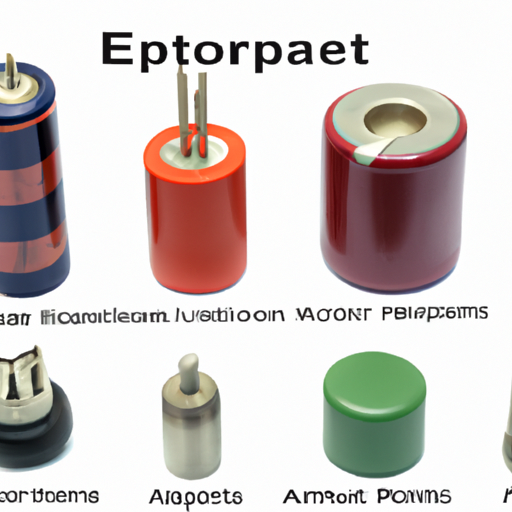
Capacitors can be categorized based on their construction and materials. The most common types include:
1. **Electrolytic Capacitors**: Known for their high capacitance values, these capacitors use an electrolyte to achieve a larger surface area for charge storage.
2. **Ceramic Capacitors**: These capacitors use ceramic materials as the dielectric and are known for their stability and reliability.
3. **Film Capacitors**: Made from thin plastic films, these capacitors are known for their low losses and high insulation resistance.
4. **Tantalum Capacitors**: These are a type of electrolytic capacitor that uses tantalum metal, offering high capacitance in a small package.
5. **Supercapacitors**: Also known as ultracapacitors, these devices can store large amounts of energy and are used in applications requiring rapid charge and discharge cycles.
Ceramic capacitors are widely used due to their small size, reliability, and cost-effectiveness. They are ideal for high-frequency applications and are commonly found in decoupling and filtering circuits.
Class 1 (Temperature Stable): These capacitors have stable capacitance over a wide temperature range, making them suitable for precision applications.
Class 2 (High Capacitance): These capacitors offer higher capacitance values but have a more significant variation in capacitance with temperature and voltage.
Electrolytic capacitors are known for their high capacitance values, making them ideal for power supply applications, audio equipment, and energy storage systems.
Aluminum Electrolytic Capacitors: These are the most common type, offering a good balance of performance and cost.
Tantalum Electrolytic Capacitors: These capacitors provide higher capacitance in a smaller size but are more expensive and sensitive to voltage spikes.
Film capacitors are known for their excellent stability, low loss, and high insulation resistance. They are commonly used in audio applications, power electronics, and timing circuits.
Polyester Film Capacitors: These are cost-effective and widely used in general-purpose applications.
Polypropylene Film Capacitors: Known for their low loss and high voltage ratings, these capacitors are ideal for high-frequency applications.
Tantalum capacitors are known for their high capacitance and reliability. They are often used in applications where space is limited, such as in mobile devices and compact electronic circuits.
While tantalum capacitors offer high performance, they can be more expensive than other types and are sensitive to overvoltage conditions, which can lead to failure.
Supercapacitors can store large amounts of energy and are capable of rapid charge and discharge cycles. They are commonly used in applications such as energy harvesting, backup power supplies, and electric vehicles.
Unlike traditional capacitors, supercapacitors can achieve capacitance values in the farad range, making them suitable for applications requiring high energy density.
Power capacitors are designed to improve the power factor in electrical systems, helping to reduce energy losses and improve efficiency. They are commonly used in industrial applications and power distribution systems.
By providing reactive power, power capacitors help to balance the load in electrical systems, reducing the demand on generators and improving overall system efficiency.
RF capacitors are designed for high-frequency applications, such as radio transmitters and receivers. They are essential for tuning circuits and signal coupling.
These capacitors must have low equivalent series resistance (ESR) and high insulation resistance to ensure optimal performance in RF circuits.
Motor run capacitors are used to improve the efficiency of electric motors during operation, while motor start capacitors provide the necessary boost to start the motor.
These capacitors are critical for the proper functioning of single-phase induction motors, ensuring smooth operation and reducing wear on motor components.
As electronic devices become smaller and more compact, the demand for miniaturized capacitors with high capacitance values is increasing. Manufacturers are developing new materials and construction techniques to meet this demand.
With growing concerns about environmental sustainability, there is a push for capacitors that use eco-friendly materials and manufacturing processes. This trend is leading to the development of capacitors that are both efficient and environmentally responsible.
Research and development in supercapacitor technology are leading to improved energy density, faster charging times, and longer lifespans. These advancements are expanding the range of applications for supercapacitors, particularly in renewable energy systems and electric vehicles.
In summary, capacitors are essential components in modern electronic circuits, with various product categories tailored to specific applications. Understanding the characteristics and applications of different types of capacitors is crucial for selecting the right component for any electronic design. As technology continues to evolve, the future of capacitor technology looks promising, with advancements in miniaturization, environmental sustainability, and supercapacitor performance paving the way for new applications and innovations.
- Academic Journals
- Industry Reports
- Manufacturer Specifications
This comprehensive overview of the important product categories of capacitors highlights their significance in electronic circuits and the ongoing advancements in capacitor technology. Whether for consumer electronics, industrial applications, or emerging technologies, capacitors will continue to play a vital role in shaping the future of electronics.